After Dark at the Canvas: A Couple's Guide to Dark-Sky Tipi Weekends

Photo: couple stargazing outside tipi dark sky countryside UK, via slangwise.com
There is a particular hush that settles over a tipi meadow once the washing-up is done and the fire has slumped into orange. Without streetlights, the sky takes over the conversation. But a stargazing break works best when you give it a little structure: a moonless weekend, a dark-sky site within easy reach, and a bag of ordinary kit that keeps you warm enough to stay out.
Start with the moon, not the telescope
The most common mistake is booking around a meteor shower and ignoring the moon. A bright moon can flatten the sky to a handful of stars. Aim for a weekend near the new moon, or at least one when the moon rises late or sets early. A quick moon-phase check takes two minutes and makes the difference between a so-so sky and a proper one.
Weather matters just as much. Clear, cold nights are often the best; cloud is the great spoiler. Keep your plans flexible and treat the forecast as part of the fun rather than a verdict. Off-season tipi breaks have an advantage here: darkness arrives early, so you do not have to stay up until midnight to see anything worthwhile.
Find the dark sky and the tipi meadow
The UK has a good spread of certified dark-sky places. Bannau Brycheiniog, Exmoor, the North York Moors, the Yorkshire Dales, the South Downs, Eryri and Galloway Forest Park all reward a bit of planning. Smaller Dark Sky Discovery Sites are often easier to reach and perfectly good for an evening with binoculars.
When you are choosing a tipi pitch, ask the owners two questions: how much local light spills into the meadow, and whether the fire pit is in a spot with an open view to the south. A site does not need to be inside a dark-sky park to be excellent. Sometimes a quiet field twenty minutes from a designated site gives you darker skies and fewer people. At Tipis on the Green, we would always choose a pitch with a clear horizon and a fire pit over a flashier location with floodlights.
What you can actually see without expert kit
You do not need a telescope to have a good night. Give your eyes twenty minutes to adjust and the naked-eye sky opens up: Orion in winter, Cassiopeia and Cygnus in autumn, the Milky Way as a soft band at genuinely dark sites, satellites sliding over, and the odd meteor. Planets are easy to spot because they tend not to twinkle. Venus, Jupiter and Saturn are all satisfying without any equipment.
A pair of 8x42 or 10x50 binoculars is the sweet spot for couples. They are light enough to pass back and forth, and they reveal the craters of the moon, Jupiter's moons, the Pleiades, the Orion Nebula and the Andromeda galaxy as a faint smudge. A red-light torch protects night vision, and a star app set to red mode is handy if you promise not to scroll.
The two-person telescope
If you already own a small telescope, a tipi weekend is a lovely excuse to use it. A 70-90mm refractor or a small tabletop Dobsonian is manageable; anything bigger becomes a job rather than a pleasure. Practise setting it up at home before you go, bring a red dot finder, and accept that one telescope between two people means taking turns. The shared wait is part of the romance.
If you are buying specifically for this trip, spend the money on warm layers and binoculars first. A cheap telescope can be more frustrating than none at all. The Geminids in mid-December are the reliable winter favourite, and in 2026 a slim crescent moon leaves most of the night dark enough to enjoy them.
Build a fireside routine
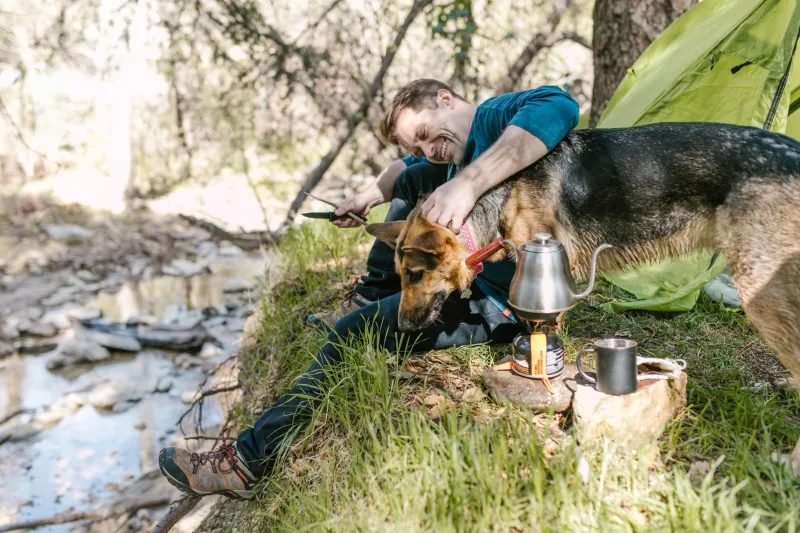
The secret to a relaxed stargazing night is to eat early and then let the evening slow down. Light the fire before dusk, set out camp chairs and blankets, fill a thermos, and keep the flames low once darkness lands. A fire that is too bright ruins your night vision; a bed of embers gives warmth without the glare.
Make a simple rhythm: look up for ten minutes, warm your hands, sip something hot, look again. Print a basic sky map or bring a small guide. Keep a shared note of what you spot, even if it is just 'bright thing near the tree'. Set an alarm for after midnight if there is a meteor shower worth catching, then retreat to a warm tipi and a hot water bottle. Nobody has to prove anything by staying out until 3am.
Packing list for a starry weekend
- Several thin layers, a hat and gloves, even in milder months
- A thermos, a flask and two decent mugs
- Binoculars, a red torch and a printed star chart
- A waterproof mat or blanket for sitting out
- Hot water bottles for the tipi
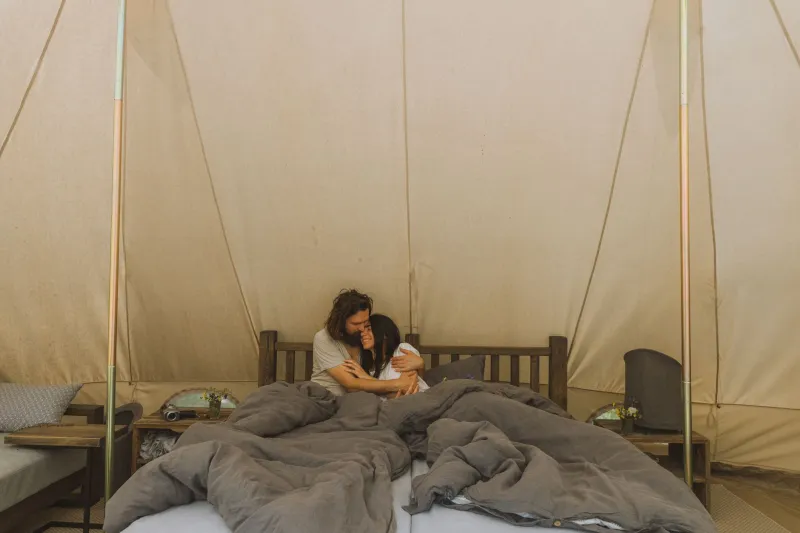
- An eye mask for the morning, because tipi canvas lets the light in
A gentle reality check
Clouds happen. If the sky closes in, have a backup that does not involve a screen: cards, a good book, a pub within walking distance, or an early night in a cosy tipi. The point of a dark-sky break is not to tick off objects. It is to share a quiet hour under a sky that feels bigger than the one at home. Pick a moonless weekend, find a meadow with a fire pit, and let the stars do the rest.